
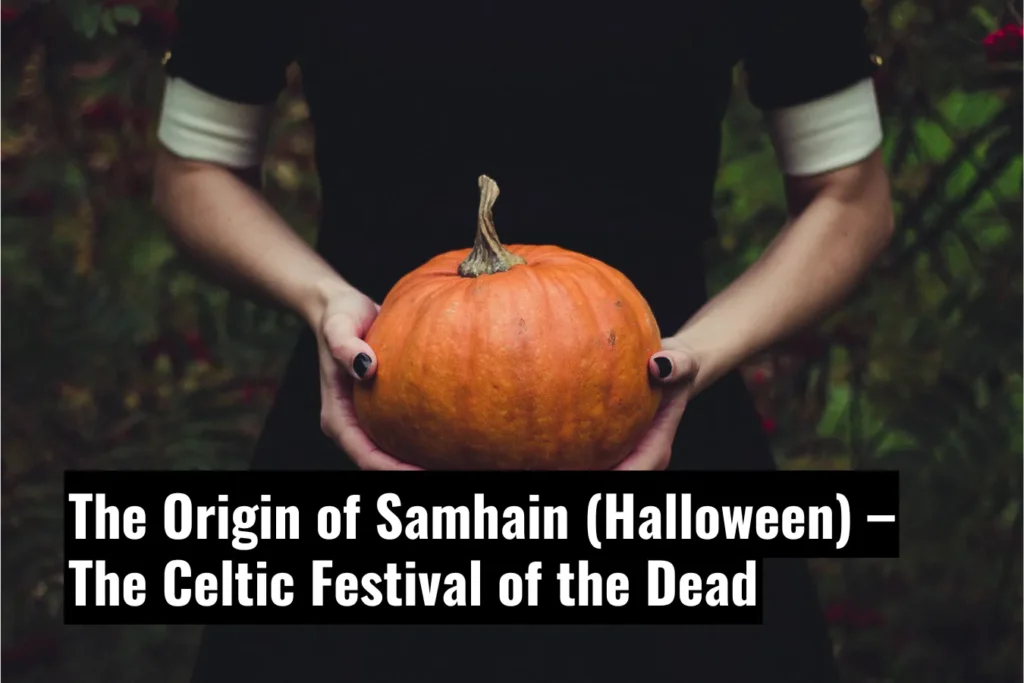
The Origin of Samhain (Halloween) - The Celtic Festival of the Dead
Luna García
Table of Contents
The origin of Samhain goes back more than 3,000 years to the Celtic festival that marked the new year and the start of the dark half. It runs from sunset on October 31 to sunset on November 1, 2026. The name is Gaelic for “summer’s end” and it is pronounced SOW-in, not Sam-hain.
What Is Samhain?
The word Samhain comes from the Gaelic language and means “summer’s end.” Samhain is considered the most important Celtic festival of the pagan European calendar, from before the rise of Christianity. It marks the Celtic New Year and the beginning of the dark season.
In the Wheel of the Year, Samhain sits between Mabon (Autumn Equinox) and Yule (Winter Solstice). It is a time of deep transition, when the boundary between the two worlds, the living and the dead, fades away and communication across the veil becomes possible. [LINK IDE: pillar article, the Wheel of the Year and Celtic festivals]
Samhain is celebrated at the time when the veil between the world of the living and the dead is at its thinnest. It is a moment of transition, where time stands still and the spirit world opens its doors to us. The presence of the Sidhe, the fairy folk, can be felt in your bones. Mother Earth begins her long rest through the six months of the dark season until she wakes again at Beltane. That is how the Coligny Calendar marks the turning of the year.
Samhain also happens to be my birthday, so to honour this date I want to share everything it represents. I hope you enjoy it. I wish you a magical, soul-filled Samhain.

When Is Samhain Celebrated? Samhain 2026 Dates
Samhain 2026 runs from sunset on October 31 to sunset on November 1. That is the date almost everyone uses. It is the one to put in your calendar. What most articles leave out is that there are three other dates with a genuine claim on it. The origin of Samhain is the reason why.
| Version of Samhain | Date in 2026 | What it marks | Who uses it |
|---|---|---|---|
| Calendar Samhain | Sunset Oct 31 to sunset Nov 1 | The traditional festival night | Almost everyone |
| Coligny three nights | Oct 31 to Nov 2 | Trinouxtion Samonii, the three sacred nights | Celtic reconstructionists |
| Astronomical Samhain | Around Nov 6 or 7 | The true midpoint between the autumn equinox and the winter solstice | Astronomy-led practitioners |
| Astrological Samhain | Around Nov 6 or 7 | The Sun reaching 15° of Scorpio | Astrologers |
| Scottish observance | November 11 | A 19th century rural custom | Parts of Scotland |
| Southern Hemisphere | May 1 | The same seasonal point, opposite half of the globe | Southern practitioners |
The fixed calendar date is symbolic. It has been observed for over 3,000 years by Celtic peoples across Europe. It coincides with the first frost in the British Isles, the blooming of juniper and the ripening of pumpkins.
In Scotland, Samhain is often celebrated on November 11th, because rural communities in the 19th century held their festivities on November 12th or 13th.
According to the ancient Coligny Calendar, a lunisolar Celtic calendar from the 2nd century, Samhain was celebrated over three nights, Trinouxtion Samonii. That suggests the festival was considered especially sacred and extended in duration.
The astronomical version is the one worth knowing about. True Samhain is the exact midpoint between the autumn equinox and the winter solstice. The astrological version is the moment the Sun reaches 15 degrees of Scorpio. Both land in early November, usually around the 6th or the 7th. This is not a modern invention. It is why the Druids are thought to have marked the festival across the first week of November rather than on a single night.
If you have ever felt that the energy of Samhain does not peak until the first week of November, you are not imagining it. You are feeling the astronomical date rather than the calendar one.

Other Names for Samhain
Samhain is known by many names depending on the Celtic region. The spread of them shows how far this festival reached across Europe.
| Name | Language or region |
|---|---|
| Samonios | Gaulish |
| Trinouxtion Samonii | Coligny Calendar |
| Oíche Shamhna | Modern Irish |
| Calan Gaeaf | Welsh |
| Samain | Old Irish |
| Samhuinn | Scottish Gaelic |
| Kala-Goañv | Breton |
| Samaín | Galician |
How Was Samhain Celebrated in Ancient Times?
Around 2,000 years ago in Celtic Ireland, Samhain marked the division between the light half (summer) and the dark half (winter) of the year. During this time the veil between this world and the Otherworld was at its thinnest, allowing spirits to pass through. Ancestors were honoured and invited into homes, while harmful spirits were warded off through ritual.
Costumes and Protection
People wore disguises and masks, often made from animal hides or natural materials, to mimic or scare away evil spirits. This ancient tradition is the origin of our modern Halloween costumes.
Cernunnos: The Horned God of the Forest
During Samhain, people paid tribute to Cernunnos, the antlered god of the wild, of nature and of the cycle of life and death. Cernunnos is often associated with the Fianna, a legendary band of Celtic warriors. His antlers represent the cycles of nature. They fall in winter and regrow in late summer, peaking in spring.
In Brittany, this seasonal symbolism lives on in the tradition of baking Kornigou, horn-shaped pastries. According to mythology the Horned God separates from his consort goddess during the light half of the year and returns to her in the dark half, surrendering his antlers in the Otherworld. This echoes the tales of Dagda and Morrighan, Celtic deities whose union occurs at Samhain before the great battle against the Fomorians.

Sacred Fire and Offerings
Bonfires and feasts played a vital role in Samhain celebrations. Each of these practices points back at Samhain as a festival of death and renewal rather than of fear.
- Animal bones were thrown into communal fires, which is where the word bonfire comes from, literally “bone-fire”.
- Household hearths were extinguished and then relit from the sacred communal fire.
- Food offerings were prepared for the spirits of ancestors and shared with the less fortunate.
- These practices honoured the cycles of death and rebirth and secured protection and blessings for the coming year.
You may also be interested in these:


Samhain at the Boyne Valley
Two hills in Ireland’s Boyne Valley are closely associated with Samhain:
- Tlachtga (Hill of Ward): the central location for the great Samhain fire festival.
- Tara: a royal ceremonial site aligned with Samhain energies.
The Mound of the Hostages at Tara, a passage tomb between 4,500 and 5,000 years old, is aligned with the sunrise during Samhain. That alignment predates the arrival of the Celts in Ireland, which means the significance of this time of year stretches further back than the Celtic festival itself.
That is the detail most retellings miss. Somebody was already marking this point in the year before there was anyone in Ireland to call it Samhain.

Samhain in Celtic Mythology
Samhain features prominently in the Ulster Cycle of Irish mythology:
- Echtra Nerai: a warrior named Nera enters the Otherworld on Samhain night.
- Cath Maige Tuired: the Dagda and Morrighan unite before a major battle with the Fomorians.
- Queen Medb of Connacht: waits until Samhain to launch a cattle raid on Cooley.
- Lugh and Fionn Mac Cumhaill also make their dramatic appearances on this sacred date.
Writers used Samhain to add a layer of magic and spiritual depth to their stories, which shows its central place in Celtic imagination and seasonal spirituality.
Samhain and the Druids
Although little written evidence survives about the Druids, since their teaching was oral, Samhain is believed to have been one of their most important festivals. Celebrations likely ran from November 1st to 7th, midway between the Autumn Equinox and the Winter Solstice.
During Samhain, Druid priests acted as mediums, communicating with ancestors and spirits in sacred ritual. To the Celts the Otherworld was not a place of punishment or fear but of perfect happiness, free of hunger and pain. They welcomed the spirits of their ancestors with joy and asked them for guidance for the year to come.
This is the part that gets flattened in modern retellings. The origin of Samhain is not a horror story. It is a family reunion that happens to cross the line between the living and the dead.
Samhain in Early Irish Literature
Samhain marked the end of the hunting and fighting seasons. Warriors such as the Fianna retired to winter camps until they returned at Beltaine.
Fionn MacCumhaill, the legendary warrior, first appeared at the royal court of Tara during Samhain. The god Lugh also made his entrance at this sacred time. When ancient storytellers wanted to create a sense of mystery and magic, they set their tales during Samhain, a night when anything was possible.
Samhain Today: From Ancient Rite to Halloween
Christianity eventually absorbed elements of Samhain into All Saints’ Day (November 1) and All Souls’ Day (November 2).
The use of costumes to scare off spirits survived in the modern tradition of Halloween. Irish immigrants brought these customs to America in the 19th century, especially during the Great Famine. There, Halloween evolved into one of the most beloved holidays.
The carving of pumpkins into Jack-o’-Lanterns also comes from Irish folklore, originally carved from turnips.
Line them up side by side and almost every Halloween tradition turns out to have a Celtic ancestor.
| Samhain practice | What survives today |
|---|---|
| Disguises worn to confuse harmful spirits | Halloween costumes |
| Lanterns carved from turnips | Jack-o’-Lanterns carved from pumpkins |
| Food left out for the ancestors | Trick or treat sweets |
| Bone-fires and relighting the household hearth | Bonfire night and autumn fire festivals |
| Welcoming the dead into the home | All Souls’ Day on November 2 |
| Divination on the night the veil is thin | Apple bobbing and Halloween fortune games |
Samhain 2026: What Makes This Year Different
Two things are worth knowing about Samhain 2026 specifically.
Samhain falls in the middle of a Mercury retrograde. Mercury turns retrograde on October 24, 2026 and stays retrograde until November 13, entirely within Scorpio. Samhain sits almost exactly in the centre of that window. If you work with the veil at all, this is the year the theme is unusually literal. Retrogrades return what you thought was finished. Samhain is the festival of the returning dead. The two are pointing at the same thing. [LINK IDE: Mercury retrograde in Scorpio 2026 article]
The moon is waning. The Full Hunter’s Moon falls on October 26, 2026, five days before Samhain, which means Samhain night lands in the waning half of the cycle. Traditionally that favours release, banishing and letting go over calling anything in. If you are choosing between two kinds of ritual this year, the waning moon is a real argument for the releasing one.
Samhain also sits inside Scorpio season, which began on October 23. Scorpio rules death, inheritance and everything hidden. That is not a coincidence anyone had to invent. The festival and the sign are describing the same six weeks of the year. [LINK IDE: Scorpio zodiac sign characteristics]
Common Misconceptions About the Origin of Samhain
Four claims come up every October and none of them hold.
- “Samhain was the Celtic god of the dead.” No such god exists in any surviving source. The idea comes from an 18th century misreading and it has been repeated ever since.
- “Halloween is a satanic festival.” Samhain predates Christianity, so it predates the Christian concept of Satan by a long way. There was nothing for it to be against.
- “The Celts made human sacrifices at Samhain.” The evidence is thin and mostly comes from Roman writers describing an enemy. Treat it the way you would treat any account written by the invading side.
- “Samhain is just Halloween with a different name.” They share an ancestor, not an identity. One is a festival of the dark half of the year. The other is a modern holiday that kept the costumes and lost the reason for them.
Getting the origin of Samhain right matters because the actual history is more interesting than the invented version.
Frequently Asked Questions
What is the origin of Samhain?
The origin of Samhain is the Celtic festival marking the end of the harvest and the start of the dark half of the year. It goes back more than 3,000 years, marks the Celtic new year and is the ancestor of modern Halloween.
How do you pronounce Samhain?
SOW-in, rhyming with “cow-in”. The Scottish Gaelic version is closer to SAV-en. It is never pronounced Sam-hain, which is the most common mistake in English.
When is Samhain 2026?
Samhain 2026 runs from sunset on October 31 to sunset on November 1. Astronomical Samhain, the true midpoint between the equinox and the solstice, falls in the first week of November, around the 6th or 7th.
Is Samhain the same as Halloween?
No. They share an ancestor. Samhain is the Celtic festival of the dark half of the year. Halloween is the modern holiday that grew out of it after Christianity absorbed parts of it into All Saints’ Day.
What does Samhain mean?
Samhain is Gaelic for “summer’s end”. It names the moment the light half of the year hands over to the dark half, which is why it also serves as the Celtic new year.
Why is the veil thin at Samhain?
In Celtic belief the boundary between this world and the Otherworld weakened at the seasonal turning points, most of all at Samhain. Ancestors could cross over, which is why they were welcomed rather than feared.
Can you celebrate Samhain if you are not a witch or a pagan?
Yes. Honouring the dead, sharing a meal and marking the end of a season are human practices, not religious tests. Plenty of people keep Samhain simply as an ancestor night.
What is the difference between Samhain and All Souls' Day?
All Souls’ Day on November 2 is the Christian observance for the dead. It absorbed the timing and some of the customs of Samhain, which is centuries older and belongs to a pre-Christian seasonal calendar.
Was Samhain really the Celtic new year?
Most sources say yes, based on the Coligny Calendar and on Irish literature setting new beginnings at Samhain. A minority of historians dispute it. It is the mainstream reading and it is not universally settled.
What colours and symbols belong to Samhain?
Black, deep red, orange and gold. Apples, pomegranates, bones, antlers, candles and the carved turnip that became the pumpkin. Each one connects to harvest, ancestors or the fire festivals.
Curious to Learn More?
The origin of Samhain is the doorway into the whole Celtic seasonal calendar. The rest of that wheel is worth walking. Samhain is one of eight festivals that divide the year. Each one carries its own mythology, its own foods and its own moment of transition. [LINK IDE: pillar article, the Wheel of the Year and Celtic festivals]
If you want to keep it simple this year, do one thing. Set a place at the table for someone you have lost, light a candle and say their name out loud. That is the oldest version of this festival and it needs nothing else.
[LINK IDE: Samhain soup recipes] [LINK IDE: Samhain salad recipes]
Follow me
If this article resonated with you, I invite you to follow me on my Pinterest profile, where I share daily inspiration to nourish the soul and uplift the spirit. Don’t miss out on the magic of every new post! Follow me and join me on this journey of connection and transformation.

Don't miss these!



- Daily Horoscopes -






- Weekly Horoscopes -
- Monthly Horoscopes -

SUBSCRIBE AND FOLLOW US!
Want to receive my weekly Tarot predictions?
🔒 Exclusive content - shared only and exclusively with subscribers!
Categories
Costumes and Protection
Getting the origin of Samhain right matters because the actual history is more interesting than the invented version.