How to Calculate Time in Tarot - A Beginner's Guide to Tarot Timing

Luna García
Table of Contents
How to calculate time in tarot is one of the most common questions beginners ask and honestly, one of the trickiest to answer. You’ve pulled your cards, you understand the message… but when will it actually happen? Days? Months? Next year?
Here’s the thing: tarot timing isn’t an exact science and that’s perfectly okay. The cards work with energy and possibilities, not a fixed clock. But there are tried and true methods that can give you a solid, meaningful timeframe and that’s exactly what this guide is here for.
Whether you’re reading for yourself or for others, understanding how to calculate time in tarot will take your readings to a whole new level. Let’s break it all down, step by step.
What Is Tarot Timing and Why Does It Matter?
Tarot timing refers to the practice of using the cards to determine when an event or outcome might unfold. Rather than pinpointing an exact date like “next Tuesday,” tarot timing gives you a general timeframe a season, a number of weeks or a cycle that helps you set expectations and prepare for what’s ahead.
Why does it matter? Because knowing when something might happen gives your readings practical value. It moves tarot from vague spiritual insight into an actionable tool for real life.
Tarot timing is the process of interpreting card symbols, suits, numbers and astrological correspondences to estimate a general timeframe for future events in a reading.

Why Tarot Timing Is Never 100% Exact
Before we dive into the methods, there’s something important to understand: how to calculate time in tarot will never give you a guaranteed date. Here’s why.
Tarot works with the energy available at the moment of the reading. Our choices, actions and free will constantly shift that energy. A job offer predicted “in three months” might come sooner if you put in extra effort or later if you hesitate.
Think of tarot timing as a weather forecast. It gives you the most likely outcome based on current conditions, but the forecast can change. That’s not a flaw it’s a feature. It reminds you that you have power over your own story.
The 4 Main Methods for Calculating Time in Tarot
How to calculate time in tarot comes down to four core methods. You don’t have to use all of them pick the one (or two) that resonates most with your reading style.
Method 1 - Using Tarot Suits for Seasonal Timing
The four suits of the Minor Arcana each correspond to a season. This is one of the most widely used systems for tarot timing and it’s perfect for beginners.
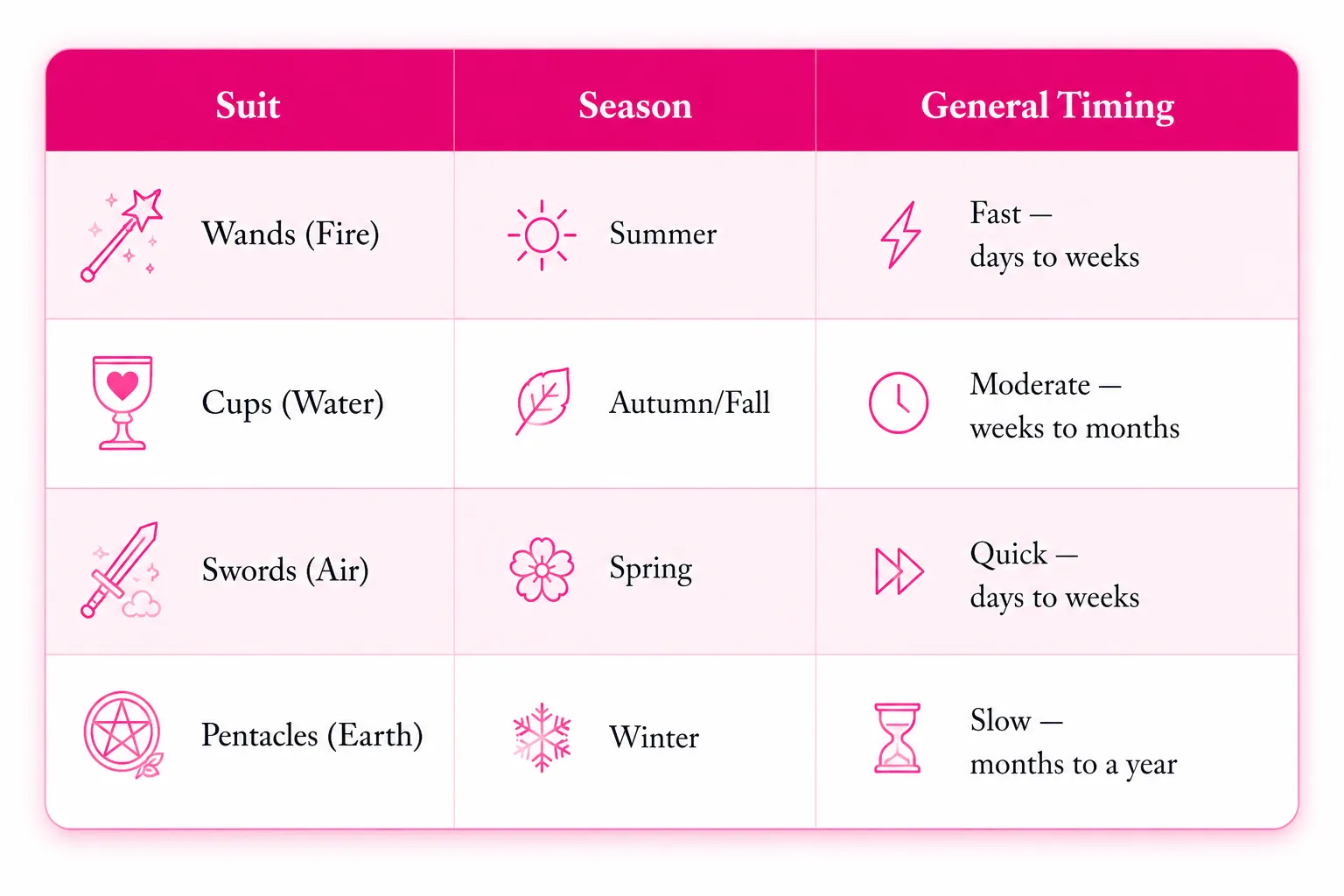
How to use this method:
Look at which suit appears most in your spread. If Wands dominate, the event is likely happening soon think hot, fast, fiery energy. If Pentacles dominate, be patient. Earth energy moves slowly and steadily.
This method is ideal when you want a broad seasonal answer to a timing question. Asking “when will I get a new job?” and pulling mostly Pentacles? Start thinking about the winter months ahead.
Method 2 - Using Card Numbers for Specific Timeframes
Every numbered card in the Minor Arcana holds a direct timing clue based on its number. This is where tarot timing gets more precise.
Here’s the basic framework:
- Aces (1): 1 day, 1 week or 1 month
- 2s through 10s: The card’s number = the number of days, weeks or months
The suit helps you determine the unit of time:
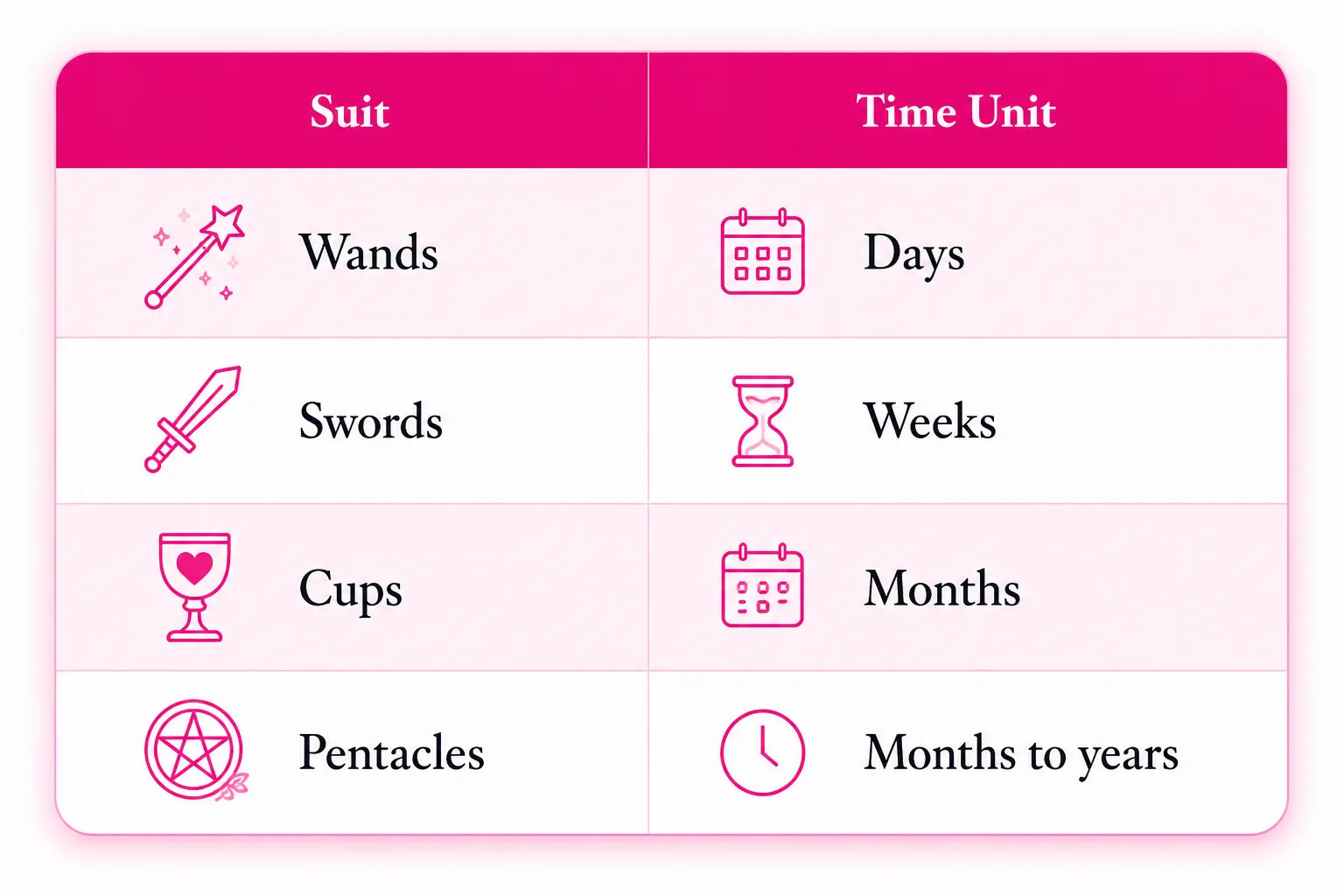
Example: The Five of Cups could indicate 5 months (Cups = months). The Three of Wands might mean 3 days (Wands = days). The Eight of Pentacles could suggest 8 months of steady effort.
For Court Cards, many readers use this scale:
- Page = 11
- Knight = 12
- Queen = 13
- King = 14
So a King of Swords might indicate 14 weeks.
If you see repeated numbers across multiple cards (like three cards all showing the number 3), that number is a strong timing signal. It might mean 3 days, 3 weeks or 3 months let your intuition guide the unit.
You may also be interested in these
Method 3 - Using the Major Arcana for Bigger Timeframes
The Major Arcana tends to indicate larger, more significant periods of time. These cards speak to major life themes and cycles, so their timing is often broader.
A common approach is to associate Major Arcana cards with astrological cycles:
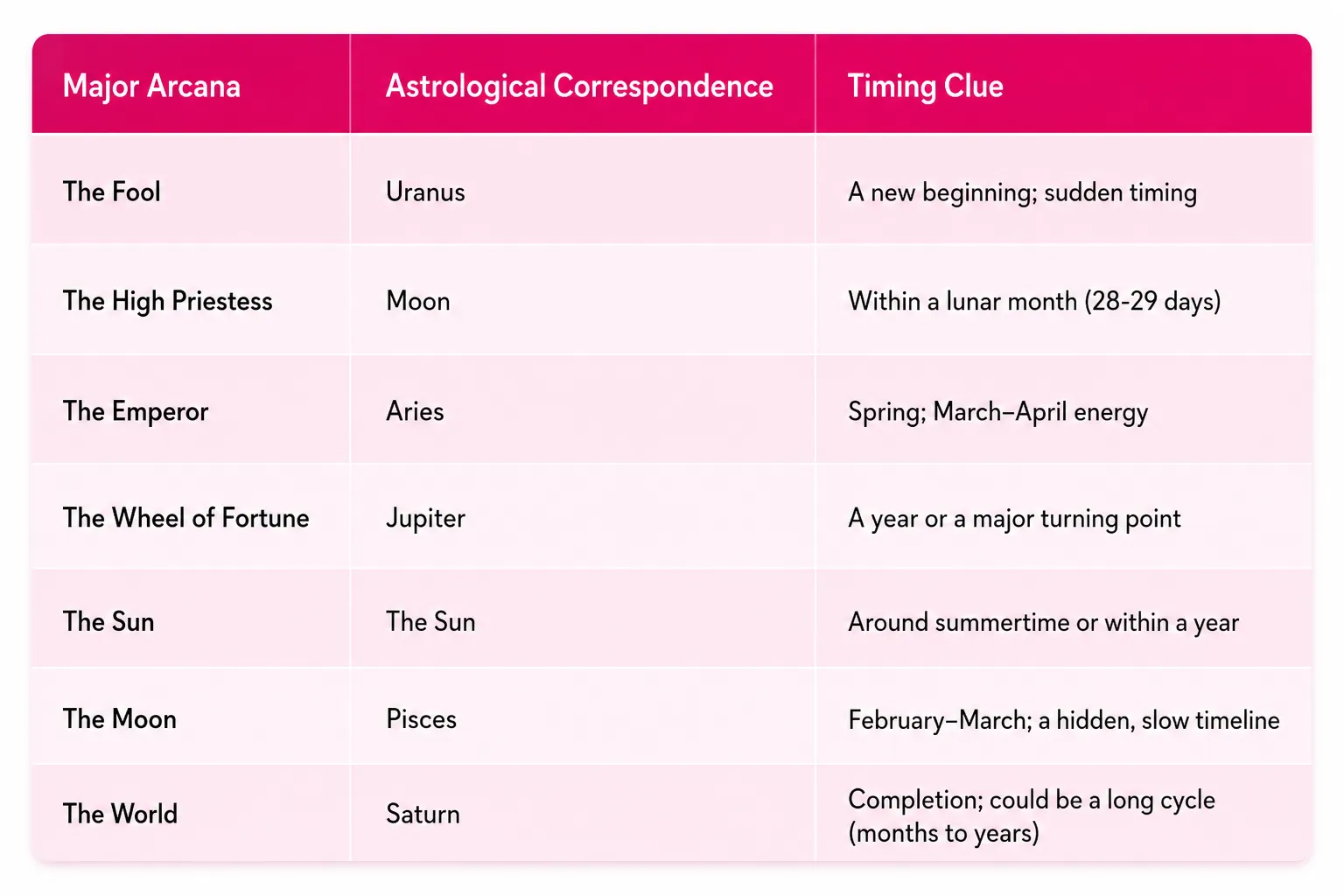
When a Major Arcana card dominates your reading, the timing is likely tied to a bigger life cycle not just a quick event. These cards say: “This is bigger than a week. Give it the time it needs.”
Method 4 - Using Spreads Designed for Timing
One of the simplest answers to how to calculate time in tarot is to design your spread around time from the start. Before you pull a single card, set your intention.
The 3 Card Timeline Spread:
- Card 1 (Left): Past influences → what has already set things in motion
- Card 2 (Center): Present moment → where energy is right now
- Card 3 (Right): Future → when and how the outcome arrives
You can also try a 12 card monthly spread, pulling one card per month to map out the year ahead. Each position = one month, starting from the current month.
The 4 Card “When?” Spread:
- What needs to happen first?
- What needs to shift in me?
- What external factor affects timing?
- When is the energy most aligned?
This spread is especially powerful because it connects timing to action it empowers you to participate in the outcome rather than just wait for it.
How to Calculate Time in Tarot - A Step by Step Approach
If you’re just starting out, here’s a simple process to follow every time you want to read timing in tarot.
- Set a timeframe intention before you pull any cards. Are you asking about the next 3 months? The next year?
- Pull your spread as you normally would.
- Identify the dominant suit. Which suit appears most often? Use the seasonal timing table above.
- Look at the numbers. Are any numbers repeated? Note the strongest number and combine it with the suit timing unit.
- Check for Major Arcana. If present, expect a larger cycle or more significant timeline.
- Trust your intuition. After applying all the logic, feel into the answer. Your gut often knows what the cards are pointing to.
Reversed Cards and Tarot Timing
Reversed (upside down) cards add an extra layer to how to calculate time in tarot. Generally, a reversed card in a timing reading signals delay or uncertainty.
A reversed card might mean:
- The event is further away than the upright position suggests
- A block or obstacle needs to be cleared first
- The timing depends heavily on the querent’s choices
Don’t be discouraged by reversals in timing readings. They’re simply telling you that conditions aren’t quite aligned yet and often, they show you what needs to change to bring the timing closer.
Tarot Timing Cheat Sheet - Quick Reference
| Card Type | Timing Range / Meaning |
|---|---|
| Wands (suit) | Days to weeks |
| Cups (suit) | Weeks to months |
| Swords (suit) | Days to weeks |
| Pentacles (suit) | Months to years |
| Aces | 1 unit (day / week / month depending on context) |
| Number cards | Number = units of time |
| Court Cards | Page–11, Knight–12, Queen–13, King–14 (symbolic timing scale) |
| Major Arcana | Larger life cycles; often astrological timing |
| Reversed cards | Delay or conditions not yet met |
Common Mistakes to Avoid When Reading Tarot Timing
Knowing how to calculate time in tarot also means knowing what not to do. Here are the most common beginner pitfalls:
- Treating the timing as fixed. Remember: free will changes outcomes. The cards show the most probable timeline, not a guaranteed one.
- Using too many systems at once. Pick one or two methods and master them before mixing approaches.
- Ignoring intuition. All the systems in the world can’t replace your gut feeling during a reading.
- Asking the same timing question repeatedly. If you’ve pulled cards for timing, trust the answer. Pulling again and again muddies the energy.
- Being too literal with numbers. A 5 might mean 5 days or 5 months context and the querent’s situation matter enormously.
When Is Tarot Timing Most Accurate?
This is a question many readers wonder about. The honest answer: tarot timing works best when the energies around a situation are already in motion and moving in a clear direction.
Think of it like reading river currents. When the water is flowing steadily, you can predict where it’s heading. When the water is still or swirling, it’s harder to know.
The most reliable timing readings happen when:
- The querent is emotionally clear about their question
- The situation has already begun to develop
- The reader uses a consistent timing system they’re familiar with
For highly uncertain situations where major life decisions haven’t been made yet it’s better to use timing as a range or a “best case scenario” rather than a fixed answer.
How to Build Your Own Tarot Timing System
Many experienced readers develop their own personal system over time. This is actually encouraged! Here’s how to start building yours:
Step 1: Choose your default “suit = time unit” system (Days/Weeks/Months/Years or another variation) and write it down.
Step 2: Track your timing readings in a tarot journal. Note the cards, the system you used and what actually happened.
Step 3: After 20-30 readings, review your journal. Which system proved most accurate for you? Adjust accordingly.
Step 4: Develop personal intuitive shortcuts. Some readers find that a particular card always signals “soon” for them personally. Note and honor these.
Your tarot timing system is a living practice it grows with you.
Frequently Asked Questions - How to Calculate Time in Tarot
Can tarot cards give an exact date?
Tarot timing rarely gives an exact date. It works with energy and probability, offering general timeframes like days, weeks, seasons or months rather than a specific calendar date.
Which tarot suit represents the fastest timing?
Wands and Swords are associated with the quickest timing typically days to a few weeks. They carry fast moving, active energy that rarely suggests long waits.
What does a reversed card mean for tarot timing?
A reversed card in a timing reading usually suggests a delay, block or condition that needs to be met first. The event may still happen just not as quickly as the upright position would indicate.
How do I calculate time in tarot using card numbers?
Match the card’s number to the suit’s time unit. Wands = days, Swords = weeks, Cups = months, Pentacles = months to years. A Five of Cups might suggest 5 months; a Three of Wands might mean 3 days.
Do Major Arcana cards represent longer timeframes?
Yes. Major Arcana cards typically indicate bigger life cycles rather than quick, specific events. They often correspond to astrological timing, suggesting seasonal or yearly cycles.
How many timing methods should I use at once?
Start with just one method and master it before combining systems. Mixing too many approaches at once can create confusion, especially for beginners learning how to calculate time in tarot.
What if multiple suits appear equally in my spread?
Look at the overall energy of the reading and use your intuition. You can also pull one additional “timing card” to clarify or focus on the card that feels most energetically prominent.
Is the astrological timing method too advanced for beginners?
It can feel complex at first, but you don’t need deep astrology knowledge to start. Simply learn which Major Arcana cards correspond to which seasons or months and build from there.
Can I create my own tarot timing system?
Absolutely. Many experienced readers develop personal systems over time by tracking their readings and noting which methods prove most accurate for them. Your system should feel intuitive and natural.
What's the best spread for timing questions?
The simple 3 card Past Present Future spread works beautifully for timing. Alternatively, design your own spread with positions assigned to specific time slots for example, “Card 1 = next month, Card 2 = in 3 months, Card 3 = in 6 months.”
Trust the Process and Your Intuition
Learning how to calculate time in tarot is a journey, not a destination. The systems and methods in this guide give you a solid foundation but ultimately, the cards speak to your intuition as much as they follow any formula.
Start with the suits and seasons method. Add the number system as you get more comfortable. Keep a tarot journal. And above all, remember: how to calculate time in tarot is less about getting the “right answer” and more about deepening your relationship with the cards.
The more you practice, the more naturally timing will flow through your readings. One day, you’ll pull a card and just know that’s the magic of tarot.
Follow me
If this article resonated with you, I invite you to follow me on my Pinterest profile, where I share daily inspiration to nourish the soul and uplift the spirit. Don’t miss out on the magic of every new post! Follow me and join me on this journey of connection and transformation.
Don't miss these!


- Daily Horoscopes -








- Weekly Horoscopes -

- Monthly Horoscopes -